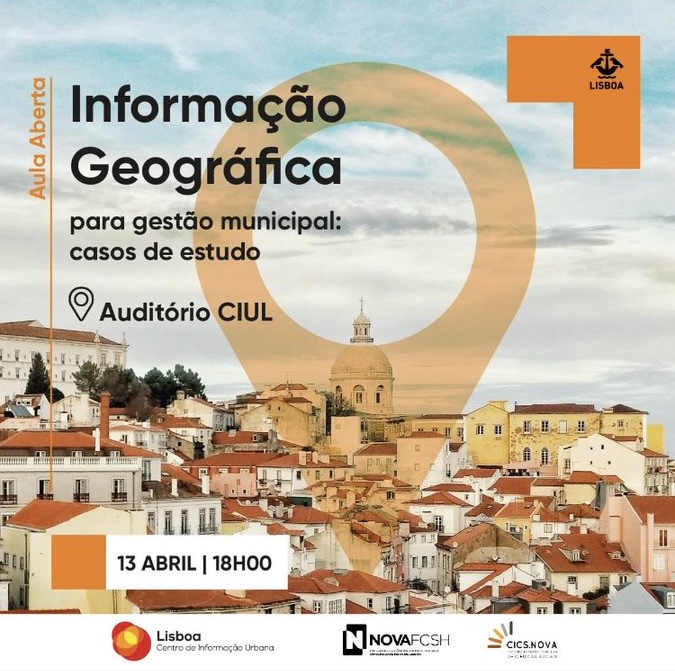
On April 13th, the auditorium of the Centro de Informação Urbana de Lisboa hosted the Open Lecture “Geographic Information for Municipal Management: Case Studies”, an event organized in collaboration with the Interdisciplinary Centre of Social Sciences (CICS.NOVA, NOVA FCSH).
Moderated by Teresa Santos and Rui Pedro Julião (CICS.NOVA, NOVA FCSH), the session brought together researchers working at the intersection of urban studies, education, and geographic information systems. The panel included Liliana Pascoeiro; and Jordi Nofre (CICS.NOVA), Manuel Garcia-Ruiz and Guilherme Costa (CIES-ISCTE), Albert Acedo(Universitat Autònoma de Barcelona), and João Carlos Martins (Universidade do Algarve).
My own contribution focused on methodological approaches to working with large-scale geographic databases in urban contexts. Drawing from fieldwork experiences and interdisciplinary collaboration, I addressed how mixed-methods frameworks—combining qualitative insights with spatial data—can offer a more nuanced understanding of contemporary urban transformations.
Throughout the event, we explored how Geographic Information Systems (GIS) can support more inclusive and evidence-based municipal strategies. From mapping socio-educational disparities to identifying hidden patterns of urban exclusion, the session highlighted the analytical and political potential of geospatial tools when used critically and reflexively.
 Manuel Garcia-Ruiz