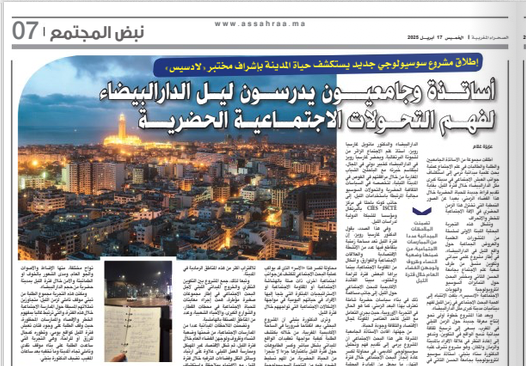
This week, Assahraa Al Maghribiya dedicated a half-page article to our research project on the nocturnal life of Casablanca. Titled “Professors and academics study the night of Casablanca to understand urban social transformations”, the article outlines our motivations, methodologies, and the broader significance of our work.
It highlights how the project focuses on nighttime urban experiences, exploring how residents navigate, occupy, and shape public space after dark. Key themes include sociability, gender dynamics, perceptions of safety, and mobility in the night. Through this work, we aim to contribute knowledge that can help inspire urban policies more attuned to the rhythms and needs of the night.
This project brings together urban sociology, cultural studies, and spatial analysis in an interdisciplinary effort to understand the city beyond daylight. As we’ve insisted throughout the project, the night is not merely the absence of light — it is a space-time with its own logics, tensions, and transformative potential.
Here is the article, translated into English:
Professors and university students study Casablanca’s night to understand urban social transformations
2025-04-17 Aziza Ghulam
A group of university professors and sociology students have launched a scientific fieldwork initiative aimed at exploring social aspects of life in a major city like Casablanca during the nighttime period. This effort seeks to offer a new reading of urban life during this space-time, far from stereotypes that reduce the night to a social scourge associated with danger or deviance.
This fieldwork, involving more than thirty students, is part of an academic course led by Dr. Manuel Garcia-Ruiz, guest researcher from the Portuguese center CIES-Iscte (Lisbon), a specialist in night studies. The initiative is also supported by Sana Benbelli, lecturer and researcher at the Faculty of Letters and Human Sciences of Ben M’sik, part of Hassan II University of Casablanca.
The project is conducted under the supervision of the Research Laboratory on Socio-Anthropological Differences and Social Identities (LADSIS), and its main objective is to encourage the sociological observation of nocturnal lifestyles. The organizers argue that the night, despite being loaded with tensions and negative imaginaries, is also a crucial space for the production of social ties, identity construction, cultural practices, and economic dynamics that deserve serious academic study.
The participating students were invited to go out into the field, to observe, record, and reflect on what happens in the streets, cafés, squares, and other public spaces of the city at night, in order to produce papers of publishable quality. These investigations also aim to address the methodological and ethical challenges linked to conducting fieldwork at night.
This pedagogical experiment, unprecedented in Morocco, also seeks to contribute to changing both the social and academic perceptions of the night. Its purpose is not only to generate scientific knowledge, but also to open pathways toward new public policies more sensitive to nighttime dynamics.
https://epaper.lematin.ma/assahraa/journal/2025/04/17/6/
 Manuel Garcia-Ruiz